
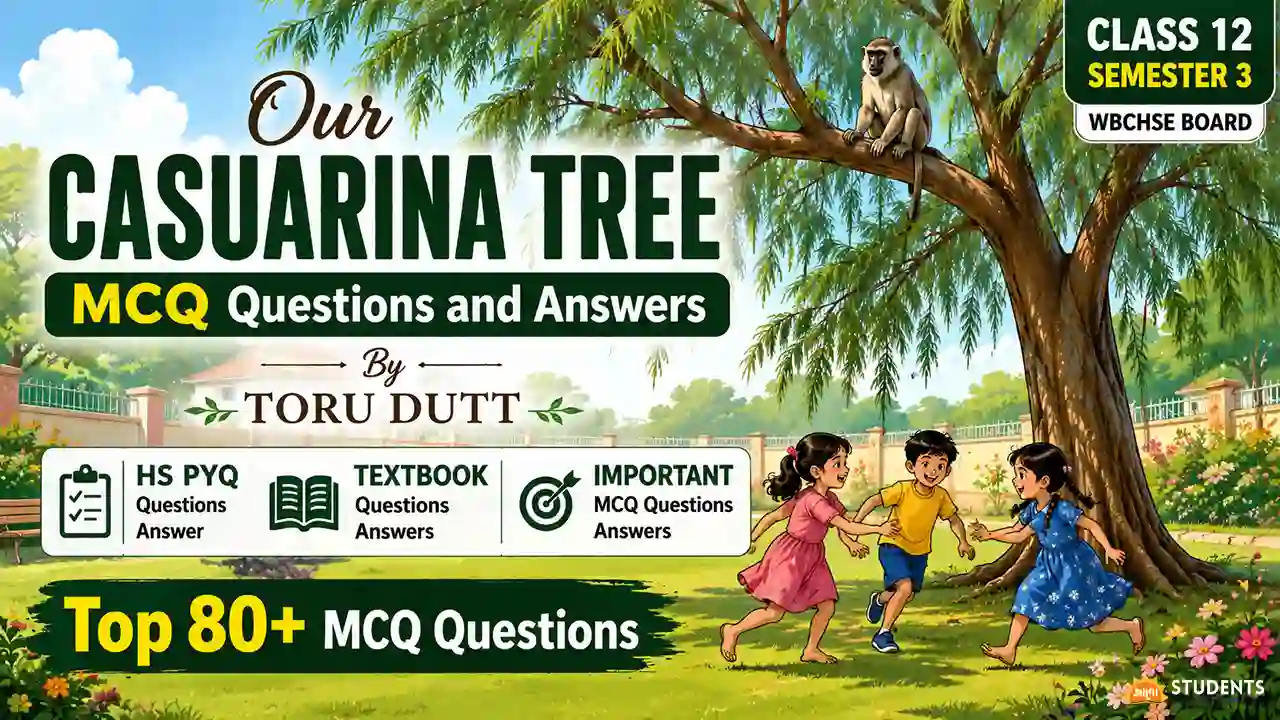
Dear students, in this post, we have published Our Casuarina Tree MCQ Questions and Answers for WBCHSE Board’s Class 12 Semester 3. The poem was composed by Toru Dutt. In this post we have discussed all the important questions from the text. We hope it will be helpful for you. Remember, nothing can replace the prescribed textbook. So, you should read the text carefully and thoroughly, paying close attention to every detail.
HS PYQ Questions Answers
1) Choose the false statement regarding the poem ‘Our Casuarina Tree’ among the following: [HS 2026]
(a) The lamentation of the tree reaches the unknown land
(b) The childhood memories of the poetess are being recalled in the poem
(c) The poetess is writing the poem in her childhood
(d) The Casuarina tree is dear to the soul of Toru Dutt
Ans: (c) The poetess is writing the poem in her childhoo.
2) Case: “It is the tree’s lament, an eerie speech…” What is the poet describing here? [HS 2026]
(a) The leaves falling off in winter
(b) The sound of the wind through the tree that seems like sorrow
(c) The tree’s flowers singing
(d) The tree weeping
Ans: (d) The tree weeping
3) “A grey baboon sits statue-like alone” [HS 2026] –
(a) Here the baboon is perching on the tree’s crest observing the sunset
(b) Here the baboon is perching on the tree’s crest observing the sunrise
(c) Here the baboon is perching on the tree’s highest branch for his prey
(d) Here the baboon is perching on the tree’s crest observing the ruin of the earth
Ans: (b) Here the baboon is perching on the tree’s crest observing the sunrise
4) The Casuarina tree in the poem is a symbol of [HS 2026] –
(a) change and impermanence
(b) loneliness and isolation
(c) strength and resilience
(d) sacredness
Ans: (c) strength and resilience
5) The poetess in “Our Casuarina Tree” wishes to preserve the tree through her [HS 2026] –
(a) memory
(b) painting
(c) prayer
(d) poetry
Ans: (d) poetry
Textbook Questions Answers
1) What does the poet mean when she says, “Beneath it we have played; though years may roll”?
(a) The tree reminds her of childhood friends and memories
(b) The tree has changed with time
(c) She dislikes the tree in the present
(d) The poet’s friends disliked the tree
Ans: (a) The tree reminds her of childhood friends and memories
2) Assertion (A): The poet hears the tree’s “dirge-like murmur” in foreign lands.
Reason (R): The sound reminds her of the friends she lost in childhood.
(a) Both A and R are true, and R is the correct explanation of A
(b) Both A and R are true, but R is not the correct explanation of A
(c) A is true, but R is false
(d) Both A and R are false
Ans: (c) A is true, but R is false
3) Arrange these feelings in the order they appear in the poem:
A. Nostalgia for childhood companies
B. Reverence for the tree’s natural beauty
C. Grief for loved ones now gone
D. A desire to immortalize the tree through verse
(a) B > A > C > D
(b) A > B > D > C
(c) C > A > B > D
(d) D > A > C > B
Ans: (a) B > A > C > D
4) Case: “But not because of its magnificence / Dear it the Casuarina to my soul:”
Question: What do these lines reveal about the speaker’s emotional connection to the tree?
(a) The speaker only admires the tree for its grand physical appearance.
(b) The speaker values the tree more for personal memories and emotional ties than its physical beauty.
(c) The speaker finds the tree unremarkable and not worth mentioning.
(d) The speaker is detached and indifferent to the tree’s presence.
Ans: (b) The speaker values the tree more for personal memories and emotional ties than its physical beauty.
5) Match the places mentioned (column A) with their significance (column B):
Column A | Column B |
a. Borrowdale | i. The original location of the Casuarina tree |
b. France | ii. Site of classical beauty where memories arise |
c. Italy | iii. A place where the poet recalled the tree abroad |
d. Native clime | iv. Trees associated with memory and loss |
(a) A-i, B-ii, C-iii, D-iv
(b) A-iv, B-iii, C-ii, D-i
(c) A-ii, B-i, C-iv, D-iii
(d) A-iii, B-ii, C-i, D-iv
Ans: (b) A-iv, B-iii, C-ii, D-i
Our Casuarina Tree MCQ Questions and Answers
1) ‘Our Casuarina Tree’ was composed by –
(a) Sarojini Naidu
(b) Virginia Woolf
(c) Alfred Lord Tennyson
(d) Toru Dutt
Ans: (d) Toru Dutt
2) ‘Our Casuarina Tree’ was published in –
(a) 1881
(b) 1882
(c) 1981
(d) 1982
Ans: (b) 1882
3) ‘Our Casuarina Tree’ was published in –
(a) Songs of Nature
(b) A sheaf Gleaned in French Fields
(c) The Bird of Time
(d) Ancient Legends and Ballads of Hindustan
Ans: (d) Ancient Legends and Ballads of Hindustan
4) Toru Dutt died at the age of –
(a) 27
(b) 23
(c) 21
(d) 25
Ans: (c) 21
5) The rhyme scheme of the poem is –
(a) ABBB-CDDD-EEE
(b) ABBA-CDDC-EEE
(c) AABB-CCDD-EEE
(d) AAAB-CCCD-EEE
Ans: (b) ABBA-CDDC-EEE
6) The creeper is compared to a –
(a) necklace
(b) scarf
(c) Python
(d) rope
Ans: (c) Python
7) What is the tone of the poem ‘Our Casuarina Tree’?
(a) Angry and resentful
(b) Bittersweet and nostalgic
(c) Playful and lighthearted
(d) Sarcastic and mocking
Ans: (b) Bittersweet and nostalgic
8) The trunk of the Casuarina tree is –
(a) short
(b) thin
(c) rugged
(d) smooth
Ans: (c) rugged
9) What winds round and round the trunk?
(a) A python
(b) A monkey
(c) A creeper
(d) A scarf
Ans: (c) A creeper
10) “Like a huge Python, winding round and round” – which figure of speech used here is –
(a) simile
(b) metaphor
(c) aliteration
(d) hyperbole
Ans: (a) simile
11) On the trunk the creeper makes –
(a) deep holes
(b) zigzag marks
(c) deep scars
(d) its trail
Ans: (c) deep scars
12) The creeper climbs near –
(a) the boughs of the Casuarina
(b) summit of the Casuarina
(c) the trunk of the Casuarina
(d) the cluster of flowers of Casuarina
Ans: (b) summit of the Casuarina
13) Who played under the Casuarina tree?
(a) The poet’s classmates
(b) The poet’s friends
(c) The poet’s siblings
(d) Village children
Ans: (c) The poet’s siblings
14) What does the poet remember when she sees the Casuarina tree?
(a) Her school days
(b) Her travels
(c) Her childhood memories
(d) Her parents
Ans: (c) Her childhood memories
15) The tree is closely associated with the poet’s –
(a) academic life
(b) married life
(c) professional life
(d) childhood memories
Ans: (d) childhood memories
16) “… in whose embraces bound” – Who is bound in the embraces?
(a) The Casuarina
(b) The Python
(c) The creeper
(d) The cluster of flowers
Ans: (a) The Casuarina
17) The tree wears the creeper –
(a) gladly
(b) timidly
(c) gallantly
(d) reluctantly
Ans: (c) gallantly
18) Who is referred to the giant?
(a) The python
(b) The Casuarina Tree
(c) The baboon
(d) The creeper
Ans: (b) The Casuarina Tree
19) The analogy of scarf actually refers to –
(a) the python
(b) the creeper
(c) the Casuarina tree
(d) the flowers
Ans: (b) the creeper
20) “The giant wears the scarf” – the figure of speech used here is –
(a) simile
(b) metaphor
(c) hyperbole
(d) alliteration
Ans: (b) metaphor
21) The Casuarina tree reminds the poet of –
(a) her lost country
(b) her lost childhood
(c) her lost siblings
(d) her lost wealth
Ans: (c) her lost siblings
22) What does the poet say about her siblings?
(a) They have gone abroad
(b) They are dead
(c) They are studying
(d) They are married
Ans: (b) They are dead
23) Who is sitting statue-like alone on the tree’s crest?
(a) A green bird
(b) A brown monkey
(c) A grey squirrel
(d) A grey baboon
Ans: (d) A grey baboon
24) According to the poet, who hails the day?
(a) Sparrow
(b) Parrots
(c) Kokilas
(d) Nightingales
Ans: (c) Kokilas
25) Who gathered all day on the boughs of the Casuarina tree?
(a) Mongooses and kokilas
(b) Birds, bees and Kokilas
(c) Bees and Kokilas
(d) Birds and bees
Ans: (d) Birds and bees
26) The flowers are hung in –
(a) silver clusters
(b) crimson clusters
(c) violet clusters
(d) golden clusters
Ans: (b) crimson clusters
27) The garden overflows with –
(a) fragrance
(b) humming of bees
(c) sweet song
(d) hooting of owls
Ans: (c) sweet song
28) When the garden overflows with the sweet song, men –
(a) get up from bed
(b) open their casement
(c) repose
(d) are busy with their work
Ans: (c) repose
29) At dawn the poetess looks at the tree through her –
(a) door
(b) binocular
(c) glass
(d) casement
Ans: (d) casement
30) The baboon sits like a –
(a) wise hermit
(b) statue
(c) guard
(d) python
Ans: (b) statue
31) Where does the baboon sit?
(a) on the crest of the tree
(b) on the lower brunch of the tree
(c) on the creeper
(d) in the shadow of the tree
Ans: (a) on the crest of the tree
32) During which season is the baboon primarily seen resting in the tree?
(a) summer
(b) spring
(c) monsoon
(d) winter
Ans: (d) winter
33) What is the colour of the baboon?
(a) black
(b) grey
(c) white
(d) black and white
Ans: (b) grey
34) The baboon sits on the crest of the tree with –
(a) its peer
(b) kokilas
(c) its puny offsprings
(d) birds
Ans: (c) its puny offsprings
35) What does the baboon do on the crest?
(a) leaps about and plays
(b) watches the stars
(c) watches the sunrise
(d) dozes off
Ans: (c) watches the sunrise
36) Where can the grey baboon’s small offspring be seen?
(a) on the lower branches of the tree
(b) on the crest of the tree
(c) under the tree
(d) in the fields
Ans: (a) on the lower branches of the tree
37) What does the baboon watch from the crest?
(a) the sunrise
(b) the gleaming moon
(c) the sunset
(d) the water lilies
Ans: (a) the sunrise
38) What does the puny offspring do?
(a) sits statue-like
(b) eats bananas
(c) leaps about and plays
(d) all of these
Ans: (c) leaps about and plays
39) How are the cows described in the poem?
(a) weary
(b) sleepy
(c) starved
(d) quiet
Ans: (b) sleepy
40) The cows head towards the –
(a) ploughing field
(b) the pastures
(c) their calves
(d) the cowshed
Ans: (b) the pastures
41) How is the tree described?
(a) brown
(b) black
(c) white
(d) hoar/grey
Ans: (d) hoar/grey
42) The shadow of the Casuarina tree falls on –
(a) on a river
(b) on a lake
(c) a small tank
(d) a broad tank
Ans: (d) a broad tank
43) What casts its shadow on the broad tank?
(a) the creeper
(b) the baboon
(c) the Casuarina tree
(d) the water-lilies
Ans: (c) the Casuarina tree
44) What flower blooms in the broad tank?
(a) lotus
(b) water-lily
(c) water poppy
(d) water iris
Ans: (b) water-lily
45) The water-lilies are compared to –
(a) water nymphs
(b) snow
(c) white scarf
(d) twinkling stars
Ans: (b) snow
46) Why is the Casuarina tree so dear to the poetess?
(a) because it bears the memory of her dear ones
(b) because of the majesty of the tree
(c) because it gives her poetic inspiration
(d) because of the natural beauty and ambience
Ans: (a) because it bears the memory of her dear ones
47) “Beneath it we have played” – Here ‘we’ refers to –
(a) Aru and Abju
(b) Toru and Anu
(c) Toru, Aru and Abju
(d) Aru and Anju
Ans: (c) Toru, Aru and Abju
48) The line “Beneath it we have played…” expresses a feeling of –
(a) mysticism
(b) medievalism
(c) nostalgia
(d) ephiphany
Ans: (c) nostalgia
49) To whom are the lines “O sweet companions…” addressed?
(a) The Casuarina tree
(b) The poet’s parents
(c) The poet’s friends
(d) The poet’s siblings
Ans: (d) The poet’s siblings
50) The poetess imagines that she can hear –
(a) heavy sighs
(b) nuptial song
(c) a sad tune
(d) dirge-like murmur
Ans: (d) dirge-like murmur
51) When the poetess thinks of the Casuarina tree associated with the memory of her siblings –
(a) she will forget all about them
(b) hot tears will blur her vision
(c) the tree comes alive in her vision
(d) her siblings come alive in her vision
Ans: (b) hot tears will blur her vision
52) The poetess compares the dirge-like murmur to –
(a) hymn
(b) rustling wind
(c) sad tune
(d) sea breaking on the shingle-beach
Ans: (d) sea breaking on the shingle-beach
53) What is actually the dirge-like murmur?
(a) the tree’s lament
(b) the twittering of birds
(c) the sound of the wind
(d) the joy of the tree
Ans: (a) the tree’s lament
54) What does the phrase ‘eerie speech’ signify?
(a) song of birds
(b) sound of waves
(c) lament of the tree
(d) rustling wind
Ans: (c) lament of the tree
55) The unknown land is well known to –
(a) prophets
(b) mystic sages
(c) supernatural spirits
(d) eye of faith
Ans: (d) eye of faith
56) Whose wail is heard ‘far, far away’?
(a) the breaking waves
(b) the siblings of the poetess
(c) the water-spirit
(d) the Casuarina tree
Ans: (d) the Casuarina tree
57) The poetess imagines that she has heard the wail in distant lands by –
(a) many sheltered bay
(b) the green meadow
(c) the Casuarina tree
(d) the obscure path
Ans: (a) many sheltered bay
58) Who was slumbered in the cave?
(a) The bay
(b) The water-wraith
(c) The waves
(d) The earth
Ans: (b) The water-wraith
59) Which classic shore received the gentle kiss of the waves?
(a) France or Italy
(b) Italy or Rome
(c) England or France
(d) Italy or Greece
Ans: (a) France or Italy
60) Who lay tranced in a dreamless swoon?
(a) The moon
(b) The earth
(c) The water-wraith
(d) The waves
Ans: (b) the earth
61) The phrase ‘form sublime’ refers to –
(a) the native land of the poetess
(b) the classic shore of France or Italy
(c) the Casuarina tree
(d) the siblings of the poetess
Ans: (c) the Casuarina tree
62) “Thy form” – here ‘thy’ refers to –
(a) the siblings of the poetess
(b) the Causarina tree
(c) her native land
(d) the grey baboon
Ans: (b) the Casuarina tree
63) What does “happy prime” refer to?
(a) the days the poetess spent in france
(b) other sweet memories in the foreign lands
(c) the happy old days spent with her siblings
(d) none of these
Ans: (c) the happy old days spent with her siblings
64) In the honour of the Casuarina tree, the poetess desires to dedicate –
(a) a dirge
(b) some flowers
(c) a book of poetry
(d) a lay or song
Ans: (d) a lay or song
65) The poet is willing to dedicate a lay in the honour of the –
(a) her siblings
(b) her native land
(c) Yew tree
(d) Casuarina tree
Ans: (d) Casuarina tree
66) Who are ‘they’ who are in ‘blessed sleep’?
(a) her siblings Aru and Abju
(b) her childhood friends
(c) her native people
(d) her parents
Ans: (a) her siblings Aru and Abju
67) “When my days are done” refers to –
(a) the death of her siblings
(b) the end of her poetry
(c) her own death
(d) none of these
Ans: (c) her own death
68) The poetess desires to immortalise the Casuarina tree through her –
(a) siblings
(b) native land
(c) oblivion
(d) poetry
Ans: (d) poetry
69) The poet compares the Casuarina tree to –
(a) the banyan trees of Borrowdale
(b) the maple trees of Canada
(c) the yew trees in Borrowdale
(d) none of these
Ans: (c) the yew trees in Borrowdale
70) What literary work can be identified in the expression “like those in Borrowdale’?
(a) Shelley’s ‘Adonais’
(b) Wordsworth’s ‘Ode to Immortality’
(c) Shakespeare’s ‘Bridal Song’
(d) Wordsworth’s ‘Yew Trees’
Ans: (d) Wordsworth’s ‘Yew Trees’
71) Where are the ‘deathless trees’ located?
(a) Borrowdale
(b) London
(c) Canada
(d) Cumberland
Ans: (a) Borrowdale
72) Where is Borrowdale Valley situated?
(a) Italy
(b) Cumberland, England
(c) France
(d) Greece
Ans: (b) Cumberland, England
73) What figure of speech is used in “May love defend thee from oblivion’s curse”?
(a) simile
(b) metaphor
(c) personification
(d) aliteration
Ans: (c) personification
74) The speaker in ‘Our Casuarina Tree’ expresses a feelings of –
(a) contentment and joy
(b) longing and nostalgia
(c) fear and anger
(d) excitement and anticipation
Ans: (b) longing and nostalgia
75) The Casuarina tree in the poem is a symbol of –
(a) strength and resilience
(b) beauty and serenity
(c) change and impermanence
(d) loneliness and isolation
Ans: (a) strength and resilience
76) What sound does the tree make, according to the poem?
(a) A dirge-like murmur
(b) A sweet song
(c) The rustling of leaves
(d) the baboon’s cry
Ans: (a) A dirge-like murmur
77) Which phrase best describes the Casuarina tree in the poem?
(a) ‘A giant wears the scarf’
(b) ‘A creeper climbs’
(c) ‘A grey baboon sits’
(d) ‘Water-lilies spring’
Ans: (a) ‘A giant wears the scarf’
78) What is the main theme explored in ‘Our Casuarina Tree’?
(a) The power of nature
(b) The importance of tradition
(c) The experience of cultural displacement
(d) The passage of time and childhood memories
Ans: (d) The passage of time and childhood memories
79) The tree’s _______ may reach the unknown land.
(a) flowers
(b) sweet song
(c) lament
(d) love
Ans: (c) lament
80) What does the poet want to preserve through her verse?
(a) The history of India
(b) The beauty of the forest
(c) Her childhood memories
(d) The physical tree only
Ans: (c) Her childhood memories
One Liner MCQ (PDF)
Read More | আরও পড়ুন
আমাদের সাইটে আপনার মূল্যবান সময় অতিবাহিত করার জন্য ধন্যবাদ। Our Casuarina Tree MCQ Questions and Answers আপনার কেমন লেগেছে জানাতে নীচে কমেন্ট বক্সে কমেন্ট করতে ভুলবেন না। তাছাড়া আমাদের সাইট নিয়ে আপনাদের কোনো মতামত বা জিজ্ঞাসা থাকলে তা নির্দ্বিধায় জানাতে পারেন।