
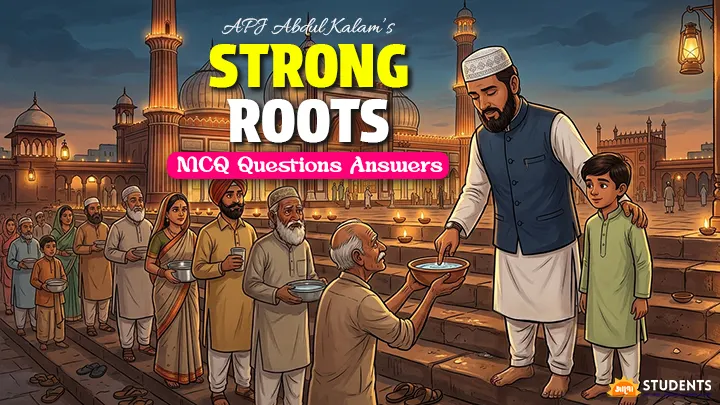
প্রিয় ছাত্রছাত্রী, আজ আমরা এই পোস্টে প্রকাশ করেছি WBCHSE বোর্ডের Class 12 এর Semester 3 -এর ইংরেজি গদ্য Strong Roots MCQ Question Answer। আত্মজীবনীটি লিখেছেন APJ Abdul Kalam। এই পোস্টে প্রতিটি গুরুত্বপূর্ণ প্রশ্নের সাথে সাথে উচ্চমাধ্যমিক পড়ে যাওয়া প্রশ্নগুলিও দিয়ে দেওয়া হল, যাতে তোমাদের প্রশ্নপত্র সম্পর্কে একটা ধারণা তৈরি হয়। আশা করছি তোমারা উপকৃত হবে। মনে রেখো, পাঠ্য বইয়ের বিকল্প কিছু হয় না। তাই টেক্স্ট বইটিকে খুব ভালোভাবে খুঁটিয়ে খুঁটিয়ে পড়তে হবে।
HS (Semester System) Questions Answers
Q1) When Kalam’s father took him to the old mosque in their locality for evening prayers, Kalam – [HS 2026]
(a) understood each and every phrase of the Arabic words that were chanted
(b) partly understood the meaning of the Arabic words that were chanted
(c) did not understand the meaning of a single Arabic word that was chanted
(d) Knew every Arabic word that was chanted by heart
Ans: (c) did not understand the meaning of a single Arabic word that was chanted
Q2) Rearrange the following statements in the correct order and select the correct option: [HS 2026]
I) They offered him bowls of water into which his father would dip his fingertips and say a prayer.
II) Kalam’s father took him to an old mosque in their locality for evening prayers and his father came out of the mosque after the prayers.
III) This would cure the invalids who would return to his father to thank him.
IV) People of different religions would be waiting for his father, when he came out of the mosque.
(a) IV, III, II, I
(b) I, II, III, IV
(c) II, IV, I, III
(d) III, IV, I, II
Ans: (c) II, IV, I, III
Q3) Kalam’s ancestral house was built in the middle of – [HS 2026]
(a) 16th century
(b) 17th century
(c) 18th century
(d) 19th century
Ans: (d) 19th century
Strong Roots MCQ Question Answer
1) ‘Strong Roots’ is written by –
(a) Ruskin Bond
(b) R.K. Narayan
(c) APJ Abdul Kalam
(d) Toru Dutt
Ans: (c) APJ Abdul Kalam
2) ‘Strong Roots’ is a/an –
(a) biography
(b) autobiography
(c) essay
(d) novel
Ans: (b) autobiography
3) ‘Strong Roots’ is taken from –
(a) Malgudi Days
(b) Wings of Fire
(c) The Roots of Fire
(d) Wings from Fire
Ans: (b) Wings of Fire
4) APJ Abdul Kalam was born in a –
(a) middle-class family
(b) lower-class family
(c) upper-class family
(d) poor-class family
Ans: (a) middle-class family
5) APJ Abdul Kalam was born in –
(a) Rameswaram
(b) Mumbai
(c) Andhra Pradesh
(d) Delhi
Ans: (a) Rameswaram
6) Rameswaram was in –
(a) Andhra Pradesh
(b) Madras
(c) Karnataka
(d) Kerala
Ans: (b) Madras
7) APJ Abdul Kalam was born in a –
(a) Oriya family
(b) Tamil family
(c) Bengali family
(d) Telegu family
Ans: (b) Tamil family
8) Abdul Kalam’s father was –
(a) Jainulabdul
(b) Jainulabdeen
(c) Jainulabdin
(d) Jainulabbas
Ans: (b) Jainulabdeen
9) Kalam’s father had –
(a) much wealth
(b) much formal education
(c) neither much formal education nor much wealth
(d) much formal education and wealth
Ans: (c) neither much formal education nor much wealth
10) Kalam’s mother was –
(a) Ashiamma
(b) Ashima
(c) Ashiama
(d) Asheeamma
Ans: (a) Ashiamma
11) Kalam’s parents were widely regarded as a/an –
(a) idle couple
(b) ideal couple
(c) sympathetic couple
(d) modern couple
Ans: (b) ideal couple
12) Kalam’s father’s ideal helpmate was –
(a) Pakshi Lakshmana Sastry
(b) Ashiamma
(c) his friend
(d) Kalam
Ans: (b) Ashiamma
13) Whose lineage was the more distinguished?
(a) Kalam’s father’s lineage
(b) Kalam’s mother’s lineage
(c) Kalam’s friend’s lineage
(d) kalam’s lineage
Ans: (b) Kalam’s mother’s lineage
14) One of the forebears of Kalam’s mother was bestowed the title of –
(a) Lord
(b) Prince
(c) Bahadur
(d) Badsha
Ans: (c) Bahadur
15) Kalam’s mother used to feed –
(a) only the members of their family
(b) only kalam and his brothers
(c) the members of their family and many outsiders
(d) none of these
Ans: (c) the members of their family and many outsiders
16) Kalam was a short boy with –
(a) distinguished look
(b) undistinguished look
(c) handsome look
(d) exceptional look
Ans: (b) undistinguished look
17) Kalam’s parents were –
(a) tall
(b) handsome
(c) tall and handsome
(d) none of the above
Ans: (c) tall and handsome
18) Kalam lived in his –
(a) rented house
(b) ancestral house
(c) bungalow
(d) cottage
Ans: (b) ancestral house
19) Kalam’s house was built in the –
(a) early of 19th century
(b) middle of 19th century
(c) late of 19th century
(d) none of these
Ans: (b) middle of 19th century
20) The house was made of –
(a) limestone
(b) brick and cement
(c) limestone and brick
(d) granite
Ans: (c) limestone and brick
21) Kalam’s ancestral house was on –
(a) the Church Street
(b) the Mosque Street
(c) the Temple street
(d) the Rameswaram street
Ans: (b) the Mosque Street
22) Kalam’s father avoided –
(a) all modern luxuries
(b) all essential comforts and luxuries
(c) all inessential comforts and luxuries
(d) all sorts of comforts and luxuries
Ans: (c) all inessential comforts and luxuries
23) Kalam’s father was –
(a) luxurious
(b) indistrious
(c) austere
(d) spiritual
Ans: (c) austere
24) Kalam was provided in his child with sufficient –
(a) playing kids
(b) money
(c) books
(d) food, medicine and clothes
Ans: (d) food, medicine and clothes
25) Kalam’s childhood was –
(a) secure
(b) uncertain
(c) emotional
(d) insecure
Ans: (a) secure
26) Kalam’s childhood was secure –
(a) emotionally
(b) materially
(c) emotionally and materially
(d) religiously
Ans: (c) emotionally and materially
27) Kalam normally ate with his –
(a) father
(b) mother
(c) parents
(d) friends
Ans: (b) mother
28) Kalam ate with his mother, sitting on the –
(a) floor of the drawing room
(b) floor of the kitchen
(c) floor of the reading room
(d) floor of the sitting room
Ans: (b) floor of the kitchen
29) Kalam’s mother served food on a/an –
(a) thermocol plate
(b) palm leaf
(c) copper plate
(d) banana leaf
Ans: (d) banana leaf
30) In Kalam’s childhood, his lunch would include –
(a) rice and sambar
(b) coconut chutney
(c) home-made pickle
(d) all of these
Ans: (d) all of these
31) Which made Rameswaram famous to the pilgrims?
(a) the Mosque
(b) the Shiva temple
(c) Meenakshi temple
(d) Ganapati temple
Ans: (b) the Shiva temple
32) The distance between the Shiva temple and Kalam’s house was –
(a) ten minute walk
(b) five minute walk
(c) fifteen minute walk
(d) twenty minute walk
Ans: (a) ten minute walk
33) Kalam’s locality was mainly –
(a) Hindu
(b) Buddhist
(c) Muslim
(d) Christian
Ans: (c) Muslim
34) Who lived amicably with their Muslim neighbours?
(a) Buddhist families
(b) Hindu families
(c) Christian families
(d) English families
Ans: (b) Hindu families
35) In Kalam’s locality the Hindu and the Muslim lived –
(a) unhappily
(b) amicably
(c) indifferently
(d) unfriendly
Ans: (b) amicably [friendly]
36) In Kalam’s locality there was an old –
(a) temple
(b) church
(c) mosque
(d) tower
Ans: (c) mosque
37) Kalam’s father would take him to the very old mosque for –
(a) evening prayers
(b) morning prayers
(c) teaching Arabic
(d) Friday prayers
Ans: (a) evening prayers
38) Kalam was taken to the mosque by –
(a) his father
(b) his mother
(c) his friend
(d) his teacher
Ans: (a) his father
39) In the Mosque, prayers were chanted in –
(a) Hindi
(b) Arabic
(c) Persian
(d) Tamil
Ans: (b) Arabic
40) About the meaning of the Arabic prayers chanted at mosque, Kalam had –
(a) the full idea
(b) the finest idea
(c) not the faintest idea
(d) the complete idea
Ans: (c) not the faintest idea
41) Outside the mosque people waited for –
(a) Kalam
(b) Kalam’s father
(c) Kalam’s mother
(d) Pakshi Lakshmana Sastry
Ans: (b) Kalam’s father
42) The people outside the mosque belonged to –
(a) Hindus
(b) Muslims
(c) Christians
(d) different religions
Ans: (d) different religions
43) People waited outside the mosque with –
(a) bowls of milk
(b) bowls of water
(c) glasses of water
(d) bunches of flowers
Ans: (b) bowls of water
44) Kalam’s father would sanctify the water provided by the people by –
(a) pouring medicine
(b) saying a prayer
(c) adding syrup
(d) by dipping his fingertips and saying a prayer
Ans: (d) by dipping his fingertips and saying a prayer
45) The water sanctified by Kalam’s father was carried home for –
(a) all the members of the family
(b) invalids
(c) children
(d) the senior members of the family
Ans: (b) invalids
46) After being cured, people would visit Kalam’s house to –
(a) only meet with Kalam’s father
(b) take advice
(c) provide fees
(d) offer thanks
Ans: (d) offer thanks
47) When people thanked Kalam’s father, he would told them to thank –
(a) Kalam
(b) Allah, the merciful
(c) Kalam’s mother
(d) Pakshi Lakshmana Sastry
Ans: (b) Allah, the merciful
48) Who was the high priest of Rameswaram temple?
(a) Pakshi Lakshmana Sastry
(b) Ram Lakshman Sastry
(c) Pakshi Lakshman Sastry
(d) Narayan Lakshmana Sastry
Ans: (a) Pakshi Lakshmana Sastry
49) The high priest was a very close friend of –
(a) Kalam
(b) Kalam’s father
(c) Kalam’s mother
(d) Pakshi Lakshmana Sastry
Ans: (b) Kalam’s father
50) Kalam’s father and the high priest used to be in –
(a) different attire
(b) traditional attire
(c) rich attire
(d) old attire
Ans: (b) traditional attire
51) Kalam’s father and Pakshi Lakshmana Sastry discussed –
(a) religious matters
(b) personal matters
(c) family matters
(d) spiritual matters
Ans: (d) spiritual matters
52) Pakshi Lakshmana Sastry was –
(a) a neighbour of Kalam
(b) the high priest of Rameswaram temple
(c) a priest of Rameswaram temple
(d) a friend of Kalam
Ans: (b) the high priest of Rameswaram temple
53) Being old enough to ask questions, Kalam asked his father about –
(a) the irrelevance of prayer
(b) the meaning of prayer
(c) the relevance of prayer
(d) the special meaning of prayer
Ans: (c) the relevance of prayer
54) About prayer, Kalam’s father told him that –
(a) prayer was an unnecessary thing
(b) prayer was not a mysterious thing
(c) prayer was a mysterious thing
(d) none of these
Ans: (b) prayer was not a mysterious thing
55) According to Kalam’s father, prayer made –
(a) a possible communion of the spirit between people
(b) an impossible communion of the spirit between people
(c) a simple communion of the spirit between people
(d) none of these
Ans: (a) a possible communion of the spirit between people
56) According to Kalam’s father, when one prays, he –
(a) transforms his body
(b) transcends his body
(c) ruins his body
(d) ascends his body
Ans: (b) transcends his body
57) According to Kalam’s father, when one prays, he becomes –
(a) a part of the heaven
(b) a part of the world
(c) a part of the cosmos
(d) a part of the hell
Ans: (c) a part of the cosmos
58) According to Kalam’s father, the cosmos knows –
(a) division of wealth and age
(b) division of caste and creed
(c) no division of wealth, age, caste or creed
(d) no bounds of time and space
Ans: (c) no division of wealth, age, caste or creed
59) According to Kalam, his father could convey complex spiritual concepts in –
(a) simple and down-to-earth Telegu
(b) simple and down-to-earth Tamil
(c) simple and complex Tamil
(d) simple and down-to-earth Bengali
Ans: (b) simple and down-to-earth Tamil
60) According to Kalam’s father, every human being is a specific element within the whole of the manifest –
(a) divine entity
(b) divine identity
(c) divine being
(d) divine existence
Ans: (c) divine being
61) When troubles come, we must try to understand the relevance of our –
(a) offerings
(b) sufferings
(c) problems
(d) existence
Ans: (b) sufferings
62) Adversity always presents opportunities for –
(a) interaction
(b) inspection
(c) introspection
(d) objection
Ans: (c) introspection
63) Kalam’s father’s answers filled him with –
(a) a strange fear and anxiety
(b) a strange energy and enthusiasm
(c) a strange awkwardness
(d) a strange feeling
Ans: (b) a strange energy and enthusiasm
64) Kalam’s father answered in a –
(a) soft voice
(b) low voice
(c) loud voice
(d) low and deep voice
Ans: (d) low and deep voice
65) Whenever human beings find themselves alone, they started –
(a) looking for friends
(b) looking for family members
(c) looking for company
(d) looking for opponents
Ans: (c) looking for company
66) Whenever human beings reach an impasse, they look for someone to –
(a) help them
(b) show them the way out
(c) accompany them
(d) advise them
Ans: (b) show them the way out
67) Whenever human beings are in trouble, they look for someone to show them –
(a) the wrong way
(b) the right way
(c) the impossible way
(d) the incorrect way
Ans: (b) the right way
68) Every recurrent anguish, longing and desire finds its own –
(a) special saviour
(b) special helper
(c) special foe
(d) special enemy
Ans: (b) special helper
69) Kalam’s father believed that for people in distress, he was –
(a) a solver of problem
(b) a mere mediator
(c) a saviour
(d) greater than God
Ans: (b) a mere mediator
70) Kalam’s father used to start his day at –
(a) 4 am
(b) 5 am
(c) 4 pm
(d) 5 pm
Ans: (a) 4 am
71) At 4am Kalam’s father used to start his day by –
(a) doing exercises
(b) reading namaz
(c) doing morning walk
(d) watering his garden
Ans: (b) reading namaz
72) Kalam’s father started his day –
(a) after dawn
(b) before dawn
(c) at dawn
(d) in the morning
Ans: (b) before dawn
73) After reading namaz, Kalam’s father used to walk down to –
(a) a small flower garden
(b) a small coconut grove
(c) a small rockery
(d) a small market
Ans: (b) a small coconut grove
74) The distance between Kalam’s home and the coconut grove was about –
(a) three kilometers
(b) three miles
(c) four kilometers
(d) four miles
Ans: (d) four miles
75) Kalam’s father returned from the coconut grove with –
(a) a dozen mangoes
(b) a dozen pineapples
(c) a dozen coconuts
(d) a dozen watermelons
Ans: (c) a dozen coconuts
76) Kalam’s father would have his breakfast after –
(a) reading namaz
(b) returning from coconut grove
(c) waking up
(d) returning from the mosque
Ans: (b) returning from coconut grove
77) Kalam’s father followed his routine even in his –
(a) early sixties
(b) late sixties
(c) early seventies
(d) late seventies
Ans: (b) late sixties
78) APJ Abdul Kalam tried to emulate his father in his won world of –
(a) art and culture
(b) physics and chemistry
(c) science and technology
(d) reality and imagination
Ans: (c) science and technology
79) Throughout his life, APJ Abdul Kalam has tried to follow –
(a) his father
(b) his mother
(c) his teacher
(d) his brother
Ans: (a) his father
80) APJ Abdul Kalam believed in the existence of a –
(a) devilish power
(b) natural power
(c) supernatural power
(d) divine power
Ans: (d) divine power
81) According to Kalam, the divine power can lift one up from –
(a) failure
(b) melancholy
(c) confusion
(d) all of the above
Ans: (d) all of the above
82) One can get freedom, happiness and peace of mind if he severs –
(a) physical and mental bond
(b) all types of bond
(c) physical and emotional bond
(d) physical and chemical bond
Ans: (c) physical and emotional bond
83) What is the significance of the title ‘Strong Roots’ in this extract?
(a) It refers to the author’s existence family lineage.
(b) It describes the lush vegetation of the author’s hometown.
(c) It symbolises the fundamental values instilled in the author during his childhood.
(d) It foreshadows the author’s future achievements in science and technology.
Ans: (c) It symbolises the fundamental values instilled in the author during his childhood.
84) What does the writer talk about in ‘Strong Roots’?
(a) His life as a scientist.
(b) His achievements in the space programme.
(c) His service to the nation as the President
(d) His childhood in his hometown
Ans: (d) His childhood in his hometown
85) “Many of them offered bowls of _______ to my father.”
(a) food
(b) water
(c) sweet
(d) soup
Ans: (b) water
One Liner MCQ (PDF)
Read More | আরও পড়ুন
আমাদের সাইটে আপনার মূল্যবান সময় অতিবাহিত করার জন্য ধন্যবাদ। Strong Roots MCQ Question Answer আপনার কেমন লেগেছে জানাতে নীচে কমেন্ট বক্সে কমেন্ট করতে ভুলবেন না। তাছাড়া আমাদের সাইট নিয়ে আপনাদের কোনো মতামত বা জিজ্ঞাসা থাকলে তা নির্দ্বিধায় জানাতে পারেন।