
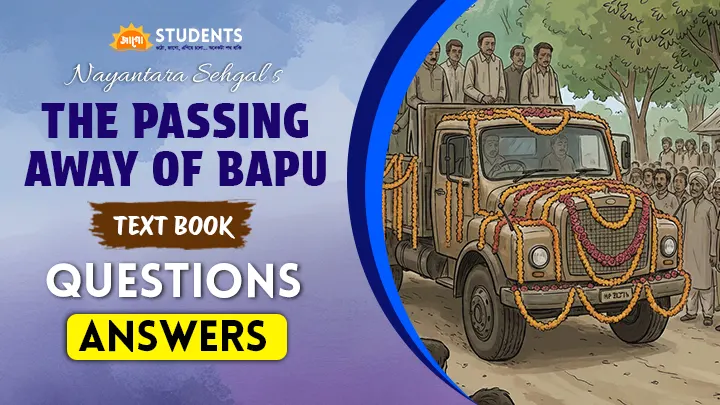
In this post we have published WBBSE’s English Prose The Passing Away of Bapu Question Answer. This prose was written by Nayantara Sehgal. In this post we have discussed all the questions and answers of the text. Bengali Meaning of the text have already published in our website. Link is provided below.
The Passing Away of Bapu Question Answer
1. Choose the correct alternative to complete the following sentences:
(a) Gandhiji had been shot on his way to –
(i) the Birla House
(ii) the author’s house
(iii) a prayer meeting
(iv) a family gathering
Ans: (iii) a prayer meeting
(b) The author came to know of Gandhiji’s death by –
(i) a letter
(ii) a telephone call
(iii) a telegram
(iv) a public broadcast
Ans: (ii) a telephone call
(c) When one is faced with the shock of a loved one’s death, one –
(i) whimpers
(ii) laughs
(iii) claps
(iv) shouts
Ans: (i) whimpers
2. Fill in the chart with information from the text:
(a) date on which Gandhiji was shot dead | 30th January, 1948 |
(b) place where Gandhiji breathed his last | Birla House |
(c) information given by the broadcast | Bapu was no more. |
3. State whether the following statements are True or False. Provide sentences / phrases / words in support of your answer:
(a) The author received an urgent telephone call in the morning. [F]
Supporting statement: I was having tea at home on the evening of 30th January, 1948, when I was called to Birla house by an urgent telephone.
(b) People attempted to break into the Birla House. [T]
Supporting Statement: They jostled one another in a stampede to break into the house.
(c) The news of Gandhiji’s death did not shock the people. [F]
Supporting Statement: The people were too stunned to speak in the beginning.
Unit – 2
4. Choose the correct alternative to complete the following sentences:
(a) Gandhiji’s funeral was to take place –
(i) on the day of his death
(ii) two days after his death
(iii) one day after his death
(iv) a week after his death
Ans: (iii) one day after his death
(b) Padmasi was Mrs. Naidu’s –
(i) niece
(ii) sister
(iii) friend
(iv) daughter
Ans: (iv) daughter
(c) While walking, Bapu used to carry in his hand a/an –
(i) flag
(ii) staff
(iii) umbrella
(iv) cane
Ans: (ii) staff
5. Complete the following sentences with information from the text:
(a) Thousands of people wept, trying to touch Bapu’s feet.
(b) The author was among people for whom walking with Bapu had a special meaning.
(c) To walk is to make slow progress.
6. Fill in the chart with information from the text:
Statement | Reason |
(a) It was impossible to move. | There was a thick crowd. |
(b) Padmasi declared that they would walk with Gandhiji in the funeral procession. | It was the last time they would be walking with Bapu. |
(c) To walk was often the only way open to the average Indian. | It required no vehicle except his own body and cost him nothing but his energy. |
Unit – 3
7. Choose the correct alternative to complete the following sentences:
(a) Gandhiji’s ashes were taken to –
(i) Ahmedabad
(ii) Allahabad
(iii) Delhi
(iv) Benaras
Ans: (ii) Allahabad
(b) A huge crowd had gathered by the –
(i) Ganges
(ii) Yamuna
(iii) Brahmaputra
(iv) Narmada
Ans: (i) Ganges
(c) Gandhiji awakened people to one another’s –
(i) indifference
(ii) jealously
(iii) suffering
(iv) greed
Ans: (iii) suffering
8. Complete the following sentences with information from the text:
(a) People on the special train sang bhajans.
(b) The author felt she had grown up within a magic circle.
(c) Bapu had passed away but his India would continue to live in his children.
9. Fill in the chart with information from the text:
Cause | Effect |
(a) People could feel Gandhiji’s presence amid the flowers and the songs. | People did not weep anymore. |
(b) The magic circle vanished. | The author felt unprotected. |
(c) The author’s values were not so weak. | The author felt that she wouldn’t lose courage so easily. |
Grammar in Use
10. Join the following pairs of sentences into single sentences as directed:
(a) I saw a snake. I ran away. (Use participle)
Ans: Seeing a snake, I ran away.
(b) He learns music. He listens to the chords. (Use preposition with gerund)
Ans: By listening to the chords, he learns music.
(c) Gold is a precious metal. It is used to make ornaments. (Use noun in apposition)
Ans: Gold, a precious metal, is used to make ornaments.
(d) Ramu has some money. He can buy books. (Use infinitive)
Ans: Ramu has some money to buy books.
(e) The sky was cloudy. We postponed our journey. (Use nominative absolute)
Ans: The sky being cloudy, we postponed our journey.
(f) The boy wrote the answer. The answer was incorrect. (Use adverbial phrase)
Ans: The boy wrote the answer in an incorrect way.
11. Join the following pairs of sentences into single compound sentences as directed:
(a) The old man is unwell. He cannot go out. (Use illative conjunction)
Ans: The old man is unwell, so he cannot go out.
(b) He is honest. He is humble. (Use cumulative conjunction)
Ans: He is not only honest but also humble.
(c) Sonali cannot write poetry. She keeps on trying. (Use adversative conjunction)
Ans: Sonali cannot write poetry, still she keep on trying.
(d) Study hard. You will not pass the examination. (Use alternative conjunction)
Ans: Study hard or you will not pass the examination.
12. Join the following pairs of sentences into single complex sentences as directed:
(a) Rabindranath Tagore is a famous poet. He won the Nobel Prize. (Use adjective clause)
Ans: Rabindranath Tagore who is a famous poet, won the Nobel Prize.
(b) He returned home. Everyone in the family had fallen asleep. (Use adverb clause)
Ans: When he returned home, everyone in the family had fallen asleep.
(c) The sun rises in the east. Everyone knows it. (Use noun clause)
Ans: Everyone knows that the sun rises in the east.
13. Join the following pairs of sentences into single sentences as directed:
(a) It rained hard. The roads were not flooded. (Compound sentence)
Ans: It rained hard, yet the roads were not flooded.
(b) He completed his work. He took rest. (Simple Sentence)
Ans: Having completed his work, he took rest.
(c) Rahul is a great singer. He can sing different kinds of songs. (Complex sentence)
Ans: Rahul who is a great singer, can sing different kinds of songs.
(d) The time of departure of the train has changed. Alia knew it. (Complex sentence)
Ans: Alia knew that the time of departure of the train has changed.
(e) I do not watch television. I do not listen to the radio. (Compound sentence)
Ans: I neither watch television nor listen to the radio.
(f) The child was short. The child could not pick the guava from the tree. (Simple sentence)
Ans: The child was too short to pick the guava from the tree.
14. Split the following into two sentences:
(a) It rained and I could not leave my room.
Ans: It rained. I could not leave my room.
(b) He thought that he could win the race.
Ans: He could win the race. He thought it.
(c) Having been informed of the trouble, the Principal left for home.
Ans: The principal had been informed of the trouble. He left for home.
(d) Nasir, who was the captain of the team, scored a century.
Ans: Nasir was the captain of the team. He scored a century.
Writing Activities
15. Write a biography of Maulana Abdul Kalam Azad (within 100 words) based on the hints given below:
[born on 11 November 1888 – composed poetry in Urdu – worked as a journalist, protested against British Raj – enthusiastic supporter of Gandhiji’s ideas – wrote many books – like ‘India Wins Freedom’, ‘Ghubar-e-Khatir’ etc. – first Education Minister of independent India – birthday celebrated as National Education Day – died on 22 February 1958]
Maulana Abdul Kalam Azad
Maulana Abdul Kalam Azad is one of the famous personalities who struggled for freedom of India. He was born on November 11, 1888 in Saudi Arabia. His father’s name was Maulana Muhammad Khairuddin and his mother was an Arabian lady. He was a noted writer and composed poetry in Urdu. He also worked as a journalist. He protested against British Raj in India. During the struggle for freedom of India, he came into close contact with Mahatma Gandhi and became an enthusiastic supporter of Gandhiji’s ideas. He wrote many books like ‘India Wins Freedom’, ‘Ghubar-e-Khatir’ and many more. He became the first Education Minister of India. His birthday is celebrated as National Education Day. He breathed his last on February 22, 1958.
16. Use the following flow-chart to write a paragraph (within 100 words) on how a building is constructed:
[drawing of a plan of the building by the architect – getting the plan sanctioned by the corporation or municipal authorities – engaging masons and labourers – starting the construction with bricks, cement and sand – fitting doors and windows – plastering of walls – wiring – electric and water connections – painting – building completed – fit for living]
How a Building Is Constructed
Constructing of a building goes through a number of steps to build it. At first a drawing of a plan of the building is to be collected from an experienced architect. Then, the plan is to be sanctioned by the corporation or municipal authorities. After getting sanction masons and labourers are engaged. Then building materials like bricks, cement and sand are collected and the construction is started. After constructing the wall, the doors and windows are fitted. Then both the outside and inside walls are plastered. After that electric wiring is done. After completing electrical wiring, electric and water connection is to be put in. Next, it needs painting. Now the building is completed and fit for living.
Read More | আরও পড়ুন
আমাদের সাইটে আপনার মূল্যবান সময় অতিবাহিত করার জন্য ধন্যবাদ। The Passing Away of Bapu Question Answer আপনার কেমন লেগেছে জানাতে নীচে কমেন্ট বক্সে কমেন্ট করতে ভুলবেন না। তাছাড়া আমাদের সাইট নিয়ে আপনাদের কোনো মতামত বা জিজ্ঞাসা থাকলে তা নির্দ্বিধায় জানাতে পারেন।